+86-13901441113


Choosing Outdoor Playground Sets in 2026 requires more than comparing bright colors and climbing features. A safe, useful playground begins with children’s real movements, not showroom appearance. Children climb, swing, slide, pause, and sometimes use equipment in unexpected ways. Your selection should reflect those behaviors.
Dr. Joe Frost, a respected playground researcher and child-development authority, stated, “Play is not a luxury; it is a necessity.” His reminder gives this decision a stronger purpose. Outdoor Playground Sets should encourage active play while supporting supervision, accessibility, and long-term durability. Look for stable platforms, secure fasteners, impact-absorbing surfacing, rounded edges, and age-appropriate challenge levels. Check whether the materials can handle rain, sunlight, muddy shoes, and repeated daily use. A beautiful set can still fail if drainage is poor or adults cannot see hidden areas.
Start with the site.
Measure the available space carefully. Include fall zones, walkways, shade, and maintenance access. In 2026, buyers may also consider modular designs, inclusive play elements, recycled materials, and smarter inspection records. However, newer technology does not automatically mean better play. Sometimes, a simple climbing wall offers more lasting value than an electronic feature.
There is no perfect playground set. Every choice involves trade-offs between cost, space, complexity, and maintenance. Recheck the manufacturer’s safety guidance and local requirements before installation. Speak with installers, educators, and children when possible. Their observations may reveal problems that product photos hide. This guide will help you compare Outdoor Playground Sets with practical judgment, evidence, and a child-centered perspective.
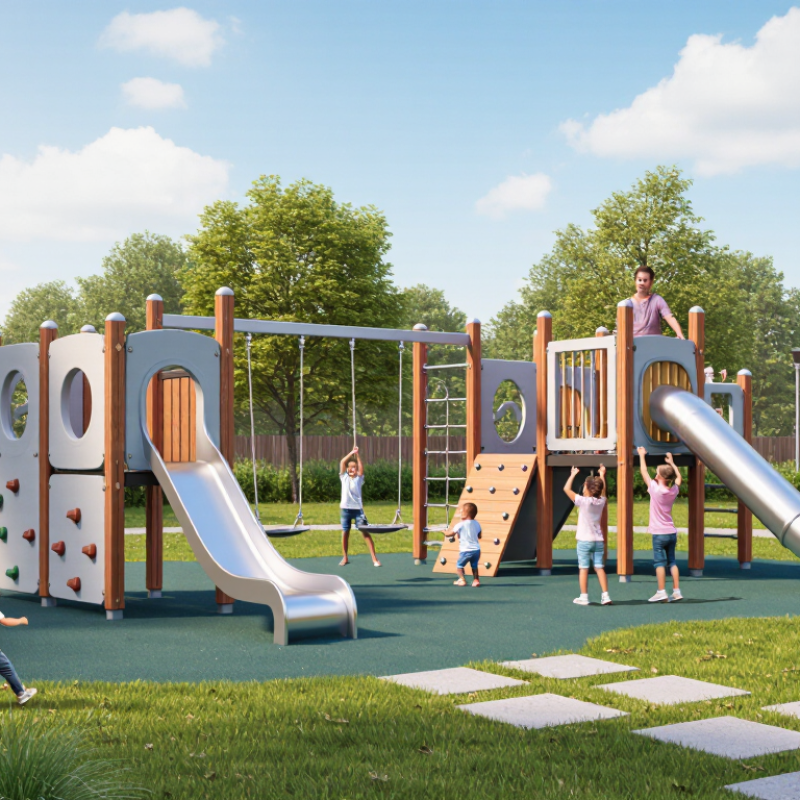
In 2026, safety selection should begin with the correct standard, not colorful slides. ASTM F1487 guides public playground equipment in the United States. EN 1176 applies across many European markets. CPSC requirements and guidance also address design, installation, surfacing, and maintenance. These systems overlap, but they are not interchangeable. Confirm which rules govern your site before comparing products.
Measure the highest accessible platform and every fall zone. Then verify impact-attenuating surfacing for that fall height. Look closely at openings near stairs, bridges, and climbing panels. A child’s head must not become trapped.
Check bolt ends, sharp edges, pinch points, and protruding ropes. The set should include clear manufacturer instructions, installation records, and inspection guidance. Ask for documented testing, not vague claims.
Walk around the proposed layout at a child’s eye level.
That reveals blind corners and crowded exits. Keep swings away from walkways and provide enough clearance around slides. ASTM F1487 and EN 1176 use detailed requirements, while CPSC guidance helps explain practical risk control. Local building, accessibility, and public-use rules may add obligations. A standard alone cannot guarantee safe behavior.
I have seen attractive equipment fail through poor surfacing installation. That mistake is easy to underestimate. Recheck drainage, loose-fill depth, anchoring, and seasonal wear.
Even a compliant set needs routine inspections. Our judgment can be imperfect, so record defects and correct them promptly. Safety is a continuing process, not a certificate on a wall.
How to Choose Outdoor Playground Sets in 2026?
Choosing a playground set starts with the children who will use it. Toddlers need low platforms, gentle steps, and enclosed climbing areas. Older children usually need challenging ladders, slides, and movement space. Check the equipment’s recommended age range and maximum user capacity. A crowded platform can turn ordinary play into a collision risk. It happens quickly.
Divide the yard into clear use zones. Place active equipment, such as swings and climbing frames, away from quiet seating or toddler areas. Keep entrances, fences, trees, and hard surfaces outside the play boundary. Leave at least six feet of open clearance around the main structure. Swings may require additional front and rear space, depending on their design. Always verify the installation guide and current local safety requirements.
Measure the site before buying. A set can fit its footprint but still block a walkway or reduce adult visibility. Maintain a clear line of sight from common supervision points. Use impact-absorbing surfacing across the full fall zone, not only beneath the slide. I have seen layouts look spacious on paper and feel cramped after installation. That is an easy mistake to underestimate. Choose durable materials, inspect connections regularly, and reassess capacity as children grow. A flexible layout may serve the family longer than the largest available set.
How to Choose Outdoor Playground Sets in 2026?
Impact surfacing deserves more attention than bright colors or climbing features. The U.S. Consumer Product Safety Commission estimates about 200,000 children receive emergency treatment yearly for playground injuries. Its Publication 325 also identifies falls as the leading injury mechanism. That makes ASTM F1292 verification a practical purchasing requirement, not a decorative specification.
ASTM F1292 measures a surface’s critical height using head-impact criteria. A tested surface should match or exceed the playground’s highest designated play surface. Ask for the complete laboratory report, including tested material, thickness, installation method, and critical-height result. Do not accept “ASTM compliant” without documents. That wording is too vague.
Look closely at real installation conditions. Loose-fill materials can scatter beneath swings and compress around slide exits. Unitary surfaces can crack, separate, or lose thickness. ASTM F1292-22 testing does not replace daily inspections. The CPSC handbook recommends checking surfacing, hardware, entrapment points, and general wear. I would photograph depth readings before opening a playground, then repeat them after heavy rain or seasonal use. Small gaps matter.
A 2-inch depth loss can change protection.
Choose certified testing over confident sales language. Also, review the test date. Older reports may not represent the supplied surface or current installation. This is where buyers often compromise, including experienced teams. That mistake deserves reconsideration.
How to Choose Outdoor Playground Sets in 2026?
An accessible playground begins with the route, not the swing set. Walk from the parking area, sidewalk, or entrance toward each major play feature. The path should be firm, stable, slip-resistant, and free from loose sand or sudden edges. For ramp sections, treat a 1:12 running slope as the maximum practical limit: every 12 inches of horizontal travel allows only 1 inch of rise. That equals an 8.33 percent slope. A gentler route feels safer for children using mobility devices and adults pushing strollers.
Measure the route after installation, not only from a plan. Soil can settle, drainage can shift, and a small lip near a ramp landing may become a real obstacle. Provide enough clear space for turning, resting, and passing. Check cross slopes too, because a path can meet the running-slope limit while still tilting uncomfortably sideways. Handrails, edge protection, and shaded rest areas may improve usability, depending on the site and local requirements.
A playground set is not genuinely inclusive if its accessible route ends beside the equipment. Connect the route to usable play platforms, transfer points, and ground-level activities. Ask an accessibility professional to review the design and confirm current local rules. I have seen attractive layouts fail during a simple wheelchair test. That small test often reveals more than a brochure. Recheck the route each season, especially after heavy rain or landscaping work.
| Evaluation Dimension | Recommended or Required Value | How to Check It | Why It Matters | Reference or Basis |
|---|---|---|---|---|
| Accessible route running slope | Maximum 1:12, or 8.33% | For every 1 inch of vertical rise, provide at least 12 inches of horizontal run. Verify with a digital slope meter. | Supports wheelchair and mobility-device access along the route to play components. | 2010 ADA Standards, Section 405.2 |
| Cross slope of the route | Maximum 1:48, or approximately 2.08% | Measure the side-to-side slope perpendicular to the direction of travel. | Reduces lateral wheelchair movement and improves stability. | 2010 ADA Standards, Sections 403.3 and 405.3 |
| Clear accessible-route width | Minimum 36 inches continuous clear width | Measure the unobstructed width between posts, guardrails, signs, landscaping, and other fixed objects. | Allows a typical wheelchair or mobility device to pass through the route. | 2010 ADA Standards, Section 403.5.1 |
| Passing spaces on long routes | Provide a 60-inch minimum diameter or 60-inch by 60-inch passing space where required | Check long routes and narrow two-way sections for adequate passing areas. | Improves two-way movement for wheelchairs, strollers, and caregivers. | 2010 ADA Standards, Section 403.5.3 |
| Ramp landings | At least 60 inches long and at least as wide as the ramp | Inspect the top, bottom, and intermediate landing areas for level, unobstructed space. | Provides room to stop, turn, and reposition a mobility device. | 2010 ADA Standards, Sections 405.7 and 405.7.3 |
| Maximum rise per ramp run | 30 inches maximum vertical rise | Divide taller level changes into multiple ramp runs with compliant landings. | Limits the length and effort of each individual ramp section. | 2010 ADA Standards, Section 405.6 |
| Handrails on ramps | Required on ramp runs with a rise greater than 6 inches or a horizontal projection greater than 72 inches; typical height 34–38 inches | Check both sides where required, graspability, continuity, and secure termination. | Provides support and improves control on sloped surfaces. | 2010 ADA Standards, Sections 405.8 and 505.4 |
| Vertical clearance | Minimum 80 inches along circulation paths | Measure beneath overhead play elements, roofs, signs, branches, and suspended equipment. | Reduces head-impact hazards for children and adults using the route. | 2010 ADA Standards, Section 307.4 |
| Ground-level accessible play components | Include varied activities such as transfer platforms, sensory panels, interactive elements, and accessible swings | Confirm that the accessible route connects to the usable entry and exit of selected components. | Provides meaningful play choices instead of access only to the perimeter. | 2010 ADA Standards, Section 240.2.1.1; ASTM F1487 design guidance |
| Accessible surface performance | Use a surface system tested for firmness, stability, and slip resistance under ASTM F1951 where accessible-route performance is claimed | Review current test documentation and inspect seams, loose fill, settlement, drainage, and changes in level. | A compliant slope is not useful if the surface is soft, rutted, unstable, or difficult to cross. | ASTM F1951; 2010 ADA Standards, Sections 302 and 303 |
| Changes in level | Up to 1/4 inch may be vertical; 1/4–1/2 inch should be beveled; over 1/2 inch requires a ramp, lift, or other compliant transition | Use a ruler or depth gauge at joints, thresholds, edging, and transitions between surfaces. | Prevents small lips and gaps from obstructing wheels or creating trip hazards. | 2010 ADA Standards, Section 303 |
| Equipment fall height | Select protective surfacing based on the equipment’s highest designated play surface and the applicable test data | Measure the highest designated play surface and compare it with the surface manufacturer’s tested critical fall height. | Helps reduce injury severity from falls. | U.S. Consumer Product Safety Commission Public Playground Safety Handbook; ASTM F1292 |
| Use-zone clearance | Maintain the equipment-specific use zone shown in the current installation and safety documentation | Check for benches, fences, tree trunks, drainage structures, and overlapping equipment zones. | Provides a safer fall and movement area around play equipment. | CPSC Public Playground Safety Handbook; ASTM F1487 |
| Age and developmental suitability | Separate play areas or equipment for ages 2–5 and 5–12 where both age groups are served | Review age labels, deck heights, challenge levels, openings, and supervision visibility. | Matches equipment difficulty and scale to children’s developmental abilities. | CPSC Public Playground Safety Handbook; ASTM F1487 |
| Inspection and maintenance plan | Document routine checks, periodic inspections, repairs, surfacing depth, drainage, and slope performance | Schedule inspections after severe weather and at intervals appropriate to usage and local requirements. | Accessibility and safety can deteriorate through settlement, wear, corrosion, or damaged components. | CPSC Public Playground Safety Handbook; applicable local building and accessibility codes |
Note: The 1:12 running-slope limit is an ADA maximum for accessible ramps and routes, not a recommended target for every site condition. Local building codes, park regulations, project specifications, and the adopted edition of accessibility standards may impose additional requirements.
How to Choose Outdoor Playground Sets in 2026?
Material choice should follow your local climate, not just appearance. Pressure-treated wood feels natural but needs regular checks for cracks, splinters, and moisture damage. Composite boards resist rot better, yet heat can make dark surfaces uncomfortable during summer afternoons. Powder-coated metal handles rain well when its coating remains intact. Salt air is less forgiving. Inspect joints, fasteners, and hidden edges for early corrosion.
Ask for specifics. A warranty should state coverage length, excluded damage, and who pays for replacement labor. Check whether fading, surface cracking, rust, and weather damage are included. Some warranties cover structural beams but exclude accessories, hardware, or installation mistakes. That difference matters after a storm. Keep purchase records and take dated photos during inspections. I would not rely on a long warranty without clear maintenance instructions.
Fall height deserves careful measurement. Measure from the highest accessible standing surface to the protective surfacing below. Higher platforms require deeper, properly maintained impact-absorbing material. Grass and thin soil can look soft but provide unreliable protection. Check the entire use zone, including swing travel and slide exits. Rubber tiles, engineered wood fiber, and loose-fill materials perform differently after rain or heavy use. Recheck depth near slide exits, where children often displace surfacing. A practical mistake is measuring only beneath the platform. The surrounding landing area matters too. Weather changes everything.
Comparison of common playground materials by climate resistance, typical structural warranty, and representative platform fall height.
Climate resistance is a 1–10 planning score based on typical resistance to UV exposure, moisture, corrosion, and freeze–thaw conditions. Warranty periods are representative commercial ranges and vary by supplier and component. Fall height is determined by the equipment design and tested surfacing system, not by material alone. Always verify compliance with ASTM F1487, CPSC guidance, or EN 1176 requirements for the installation region.